


The relevance of Mahatma Gandhi in the current context
A relevância de Mahatma Gandhi no contexto atual
Mahatma Gandhi is one of the most remarkable figures in modern history. He not only led the fight for India's freedom, but also inspired movements for justice, equality, and peace throughout the world. On his birthday, October 2nd, the International Day of Non-Violence is celebrated. In this era of rapid globalization, technological change, political polarization, economic uncertainty, social unrest, and ecological crises, the relevance of his teachings is even more pressing.
Gandhi and Politics: Mahatma Gandhi's political philosophy enshrines justice, freedom, ethical politics, and the participation of ordinary people in decision-making. In today's world, where democracies face crises of credibility due to corruption, voter apathy, and populist polarization, Gandhi's vision offers lessons for strengthening local government, participatory budgeting, and community-driven development projects. In public life, he believed in ethical leadership, integrity, and transparency, and that social harmony can be achieved through truth, non-violence, and mutual respect. His vision of dignity, equality, and non-discrimination is central to contemporary struggles against racism, sexism, and xenophobia. He advocated peaceful political action against systemic injustice – a moral force that dismantled an empire without resorting to armed struggle.
Gandhi and the economy: Gandhian economics is based on the principle of "need over greed" and that each generation manages wealth for the next. He advocated for the idea of subsistence and sustainability. His words, "The world has enough to satisfy everyone's needs, but not enough to satisfy everyone's greed," expose the limits of a consumer-driven economy. He urged the wealthy to act as stewards of social wealth, a model that resonates today in corporate social responsibility (CSR) and good business practices. His ideas of self-sufficiency resonated during COVID, which exposed the vulnerabilities of global supply chains. Governments worldwide are reconsidering national production, sustainable agriculture, and community-based economies. Gandhi advocated for an external vision rooted in internal strength. His ethical question, "What is the impact on the weakest?" remains crucial for addressing inequality, and using this criterion, he urged policymakers to ensure inclusive growth.
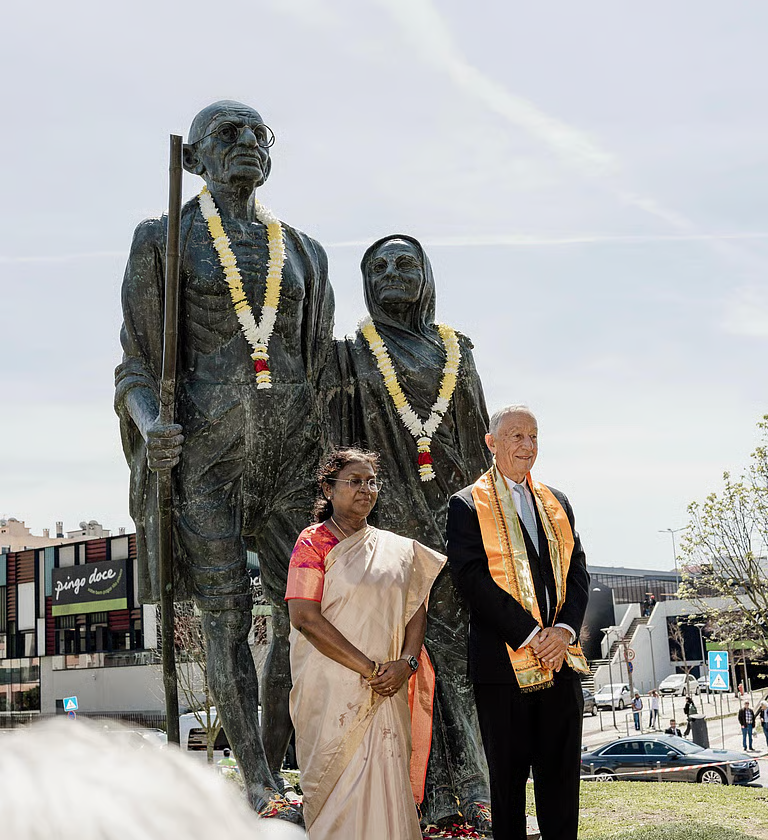
Indian President Draupadi Murmu with her Portuguese counterpart, Marcelo Rebelo de Sousa, next to a statue of Gandhi in Lisbon.
Gandhi and the Environment: Climate change, deforestation, and pollution are rapidly pushing humanity toward a survival crisis. Gandhi's lifestyle of voluntary simplicity and warnings against reckless consumption anticipated current ecological concerns. The LiFe ( Lifestyle for Environment ) mission, championed by Prime Minister Modi, is based on this principle. His ideas are reflected in sustainable development, minimalism, zero-waste lifestyles, and global ecological conservation movements. Today, the ethical dimension of climate change, which has a greater impact on the poor despite their lower emissions, demands Gandhian thinking. His ideas prioritized vulnerable communities.
Gandhi and global peace: Gandhi was nominated five times for the Nobel Peace Prize, but never received it. This has been a source of regret for the Nobel committee, expressed on several occasions. In an era of nuclear weapons, terrorism, and proxy wars, his call for peace through nonviolence, dialogue, and reconciliation is a moral compass. Leaders such as Martin Luther King Jr., Nelson Mandela, and Desmond Tutu were directly inspired by Gandhi. He insisted that peace is not merely the absence of war, but a culture fostered through education, tolerance, and justice. In an interconnected but divided world, his message of peaceful coexistence remains indispensable.
Gandhi and Ethics in Daily Life: The Gandhian path is not a relic of the past, but a guide for the future. His personal ethics are profoundly relevant. Today, this could include the search for truth in the age of misinformation, respectful dialogue to mitigate conflicts, and ethical consumer choices. His philosophy of non-violence, truth, simplicity, and inclusion offers lasting solutions to problems such as war, inequality, environmental crisis, political corruption, and moral decay. Mahatma Gandhi said, "My life is my message," but he never asked to be copied verbatim. It is up to us to creatively adapt and reinterpret his ideas for contemporary challenges.
Ambassador of India